Hybrid Solar Systems with Battery Storage: A Complete Guide

Hybrid solar systems are becoming increasingly popular in India because they combine the advantages of both grid-connected solar systems and battery backup systems. These systems allow homes and businesses to generate electricity from solar panels while storing excess energy in batteries for later use.
With frequent power outages in many regions and rising electricity costs, hybrid solar systems provide a reliable solution for uninterrupted power supply. By combining solar energy generation with battery storage, users can reduce their dependence on the electricity grid while ensuring power availability during outages.
Hybrid solar technology has evolved significantly in recent years, making these systems more efficient, affordable, and suitable for residential as well as commercial applications.
What Is a Hybrid Solar System
A hybrid solar system is a solar power system that integrates solar panels, battery storage, and grid connectivity. It allows the system to operate in multiple modes depending on energy availability and consumption.
During the daytime, solar panels generate electricity that powers appliances and charges the batteries. When solar production exceeds demand, excess electricity can either be stored in batteries or exported to the grid.
When solar generation is low or during nighttime, the system can draw energy from the battery or the electricity grid.
Key features of hybrid solar systems
- Solar power generation during the day
- Battery storage for backup power
- Grid connectivity for additional supply
- Smart energy management system
These systems provide flexibility and energy security for both homes and businesses.
Main Components of a Hybrid Solar System
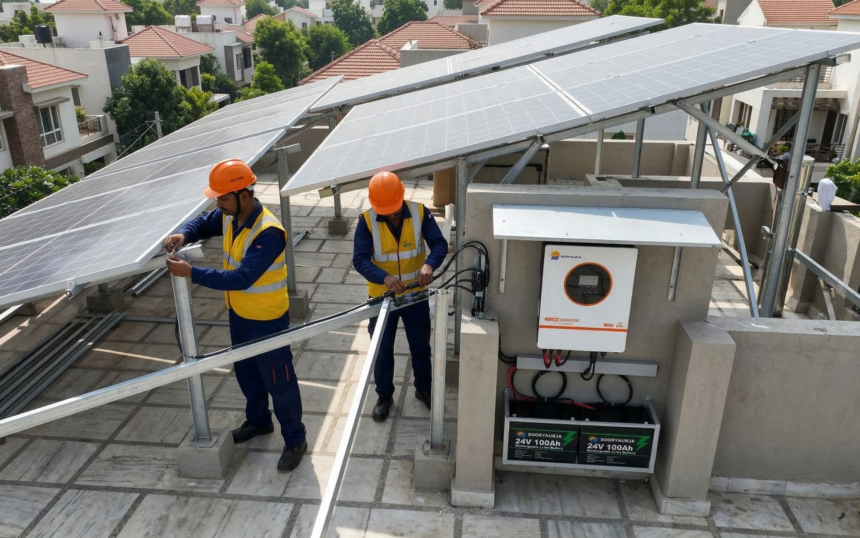
A hybrid solar system includes several important components that work together to generate, store, and distribute electricity.
| Component | Function |
|---|---|
| Solar Panels | Convert sunlight into electricity |
| Hybrid Inverter | Manages solar generation and battery charging |
| Battery Bank | Stores excess energy for backup use |
| Mounting Structure | Holds solar panels securely |
| Electrical Wiring | Transfers electricity through the system |
| Monitoring System | Tracks energy generation and usage |
Each component must be properly installed and configured to ensure efficient system operation.
How Hybrid Solar Systems Work
Hybrid systems use intelligent energy management to optimize solar generation, battery storage, and grid usage.
Typical hybrid system workflow
- Solar panels generate electricity during the day
- Solar energy powers home or business appliances
- Excess electricity charges the battery bank
- If batteries are full, extra power may be sent to the grid
- During nighttime or outages, batteries supply electricity
This process ensures continuous power availability even when sunlight is unavailable.
Advantages of Hybrid Solar Systems
Hybrid solar systems offer several benefits compared to traditional grid-tied solar installations.
Major advantages include
- Backup power during electricity outages
- Reduced dependence on the utility grid
- Lower electricity bills
- Efficient energy storage and management
- Increased energy independence
These benefits make hybrid systems ideal for locations where reliable electricity supply is a concern.
Battery Storage in Hybrid Systems
Battery storage is one of the most important components of a hybrid solar system. Batteries store excess solar energy generated during the day so it can be used when solar production is unavailable.
Most hybrid systems use battery banks configured to match the inverter voltage requirements.
| Battery Type | Characteristics |
|---|---|
| Lead Acid Battery | Affordable but requires maintenance |
| Lithium-Ion Battery | Higher efficiency and longer lifespan |
| Gel Battery | Maintenance-free sealed battery |
In many residential systems, a battery bank of four 12V batteries connected in series to form a 48V system is commonly used.
Hybrid Solar System Installation Process
Installing a hybrid solar system requires careful engineering and professional installation.
Typical installation stages
- Energy consumption analysis
Evaluate electricity usage and backup requirements. - System design
Determine solar panel capacity, inverter size, and battery storage. - Installation of mounting structures
Panels are installed on rooftops or ground-mounted structures. - Electrical system integration
Inverter and battery systems are connected with proper wiring. - Testing and commissioning
The system is tested for performance and safety.
Professional solar EPC companies ensure the installation meets safety and performance standards.
Hybrid Solar System Applications
Hybrid solar systems are suitable for a wide range of applications across residential and commercial sectors.
Common uses include
- Residential homes with backup power needs
- Commercial buildings and offices
- Hospitals and healthcare facilities
- Educational institutions
- Small industries and shops
Hybrid systems are particularly useful in areas where electricity supply is unreliable.
Performance and Efficiency Factors
Several factors affect the efficiency and output of hybrid solar systems.
| Factor | Impact |
|---|---|
| Solar panel orientation | Correct direction improves energy production |
| Battery capacity | Larger batteries provide longer backup |
| Inverter quality | Efficient energy conversion improves performance |
| Maintenance | Regular maintenance ensures system reliability |
Professional system design helps optimize performance and extend system lifespan.
Maintenance and System Monitoring
Hybrid solar systems require periodic maintenance to maintain optimal performance.
Recommended maintenance activities
- Cleaning solar panels regularly
- Inspecting battery connections
- Checking inverter performance
- Monitoring energy production through software
Most hybrid systems include smart monitoring platforms that allow users to track electricity generation and battery status in real time.
Future of Hybrid Solar Systems
Hybrid solar systems are expected to grow rapidly as battery technology improves and solar equipment becomes more affordable. The integration of advanced energy storage systems and smart energy management technologies will further increase system efficiency.
With rising electricity demand and growing interest in energy independence, hybrid solar systems will continue to play a major role in the renewable energy sector.
Conclusion
Hybrid solar systems provide an ideal combination of solar energy generation, battery backup, and grid connectivity. These systems offer reliable power supply, reduce electricity costs, and increase energy independence for both residential and commercial users.
As solar technology continues to evolve, hybrid solar systems will become one of the most practical solutions for sustainable energy generation and reliable electricity supply in the future.